
How to Brand a Luxury Real Estate Development: A New York Branding Studio's Guide
By Micha Riss, Founder & President at Flying Machine Last updated: May 6, 2026
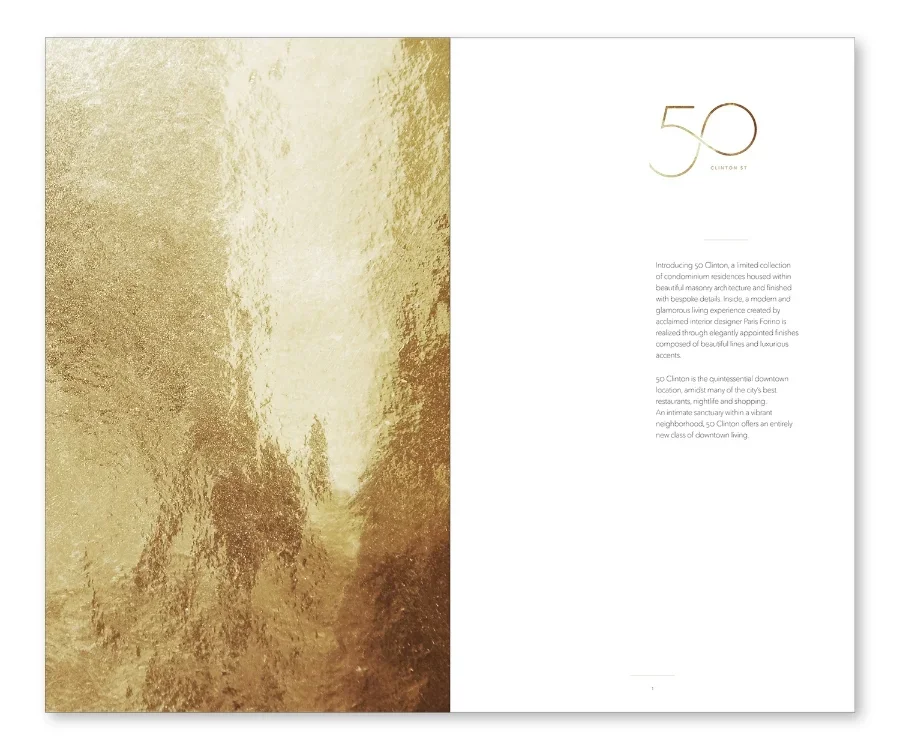
Luxury real estate branding by Flying Machine NYC - 50 Clinton Street brochure for Douglas Elliman
Direct answer
Branding a luxury real estate development is the process of creating a name, identity, and marketing system that turns a building into a buyable story before the foundation is poured. It runs in five phases - research and positioning, naming, visual identity, brand applications (brochure, website, signage, sales center), and launch - and typically takes 12 to 20 weeks. The goal isn't to make the building look pretty in a brochure. It's to compress the buyer's journey from curiosity to deposit.
Below is how we run it, drawn from twenty years of branding NYC residential developments - projects like 50 Clinton Street with Douglas Elliman, HFZ Capital Group's portfolio, Toll Brothers' 303 East 33rd, and Brack Capital's NYC work.
Why brand identity matters for residential real estate
A luxury development is sold on three things: the location, the product, and the brand. The first two are mostly fixed by the time we get the call. The brand is the only variable left to move.
In a competitive Manhattan launch - where five comparable buildings might break ground in the same year - the brand is what makes a buyer call your sales office instead of the one across the street. It's also what justifies the price per square foot premium that pays for the project's margin. A weak brand on a strong building leaves money on the table. A strong brand on a strong building closes faster, at higher prices, with less concession.
Two examples from our work. 303 East 33rd, the first LEED-registered Toll Brothers condominium in NYC, sold over 60% of its units in the first couple of months from launch - driven by a "303-in-a-tree" identity and a witty NY Times ad campaign that paired unit amenities with neighborhood iconography. 50 Clinton Street, the Douglas Elliman / Fredrik Eklund project on the Lower East Side, hit the same 60% sold-in-month-one mark behind a gold-embossed brochure and a logo system tuned to "raw luxury." Different buildings, different neighborhoods, different budgets - same outcome when the brand is right.
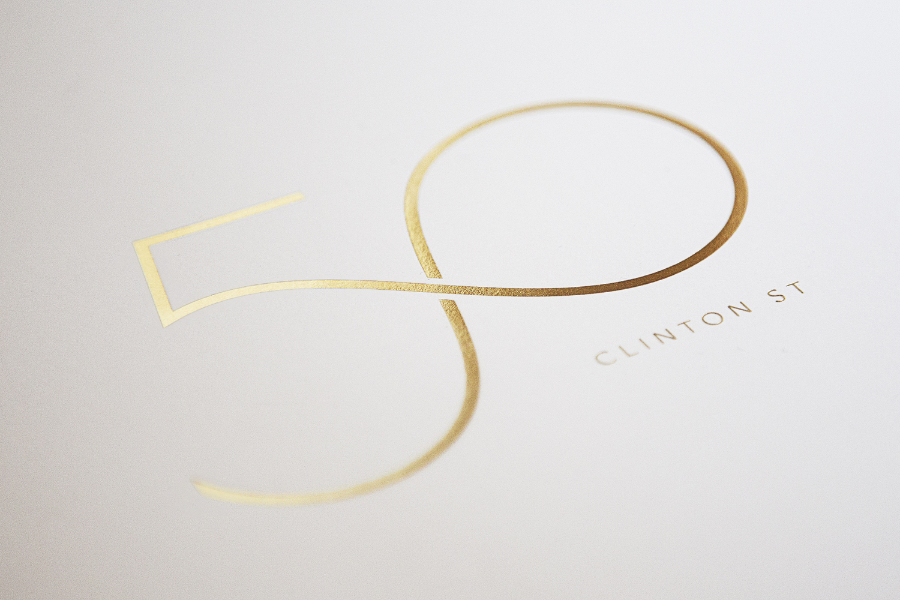
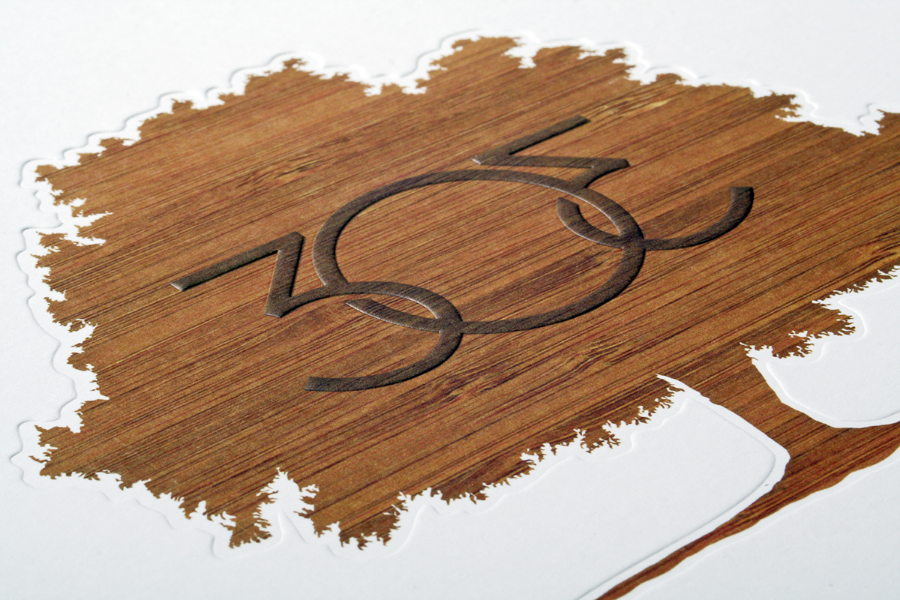
Luxury real estate brand identity examples by Flying Machine - 50 Clinton Street and 303 East 33rd
Step 1: Research and positioning (the brief)
This is the phase clients want to skip and the phase that determines everything else. Two to three weeks.
The questions we're answering: Who is this building for, exactly? Not "luxury buyers" - luxury buyers are a category, not a target. We're trying to identify the specific buyer profile (the empty nester downsizing from a townhouse, the international family seeking a New York pied-à-terre, the first-time luxury buyer who just exited a tech company). What do those buyers already believe about your neighborhood, your developer, and your competitors? What gap can this building credibly fill?
We do this through three streams of work in parallel: leadership interviews with the developer and architect, a market audit of every comparable launch in the submarket, and a buyer-mindset analysis that maps what competing brochures are saying versus what buyers are actually responding to. The output is a single positioning document - usually under ten pages - that defines who the building is for, what it stands for, and what the brand will need to express. Every subsequent decision answers to this document.
Step 2: Brand strategy and naming
Naming is the most overrated and underrated part of the project at the same time.
Overrated, because the wrong name will not kill a great building. Buyers will buy "157 East 84th Street" if the product is right. Underrated, because the right name compresses everything you'd otherwise have to say. The Belnord. The Marquand. 50 Clinton. Each of those names does work in the buyer's head before a single piece of marketing is shown.
The naming work runs in parallel with strategy and takes one to two weeks. We typically develop 30 to 50 candidate names, screen them against trademark and URL availability, narrow to three to five recommended directions, and pressure-test the finalists with the developer's leadership. A good development name does at least two of three things: it locates the building (a neighborhood, a number, a landmark), it signals the lifestyle (heritage, modernity, escape), and it sounds inevitable when you say it out loud. If it does all three, it's a winner.
Strategy and naming together produce the brand articulation - a one-paragraph statement of what the building is, who it's for, and why it matters. For HFZ Capital Group's portfolio identity, that articulation was Bold Endeavors. Understated Approach. For 303 East 33rd, it was a "first of its kind" green-luxury position. The articulation is the spine of every later decision.
Step 3: Visual identity design
Three to five weeks. This is where the building gets its face.
A luxury real estate brand identity typically includes:
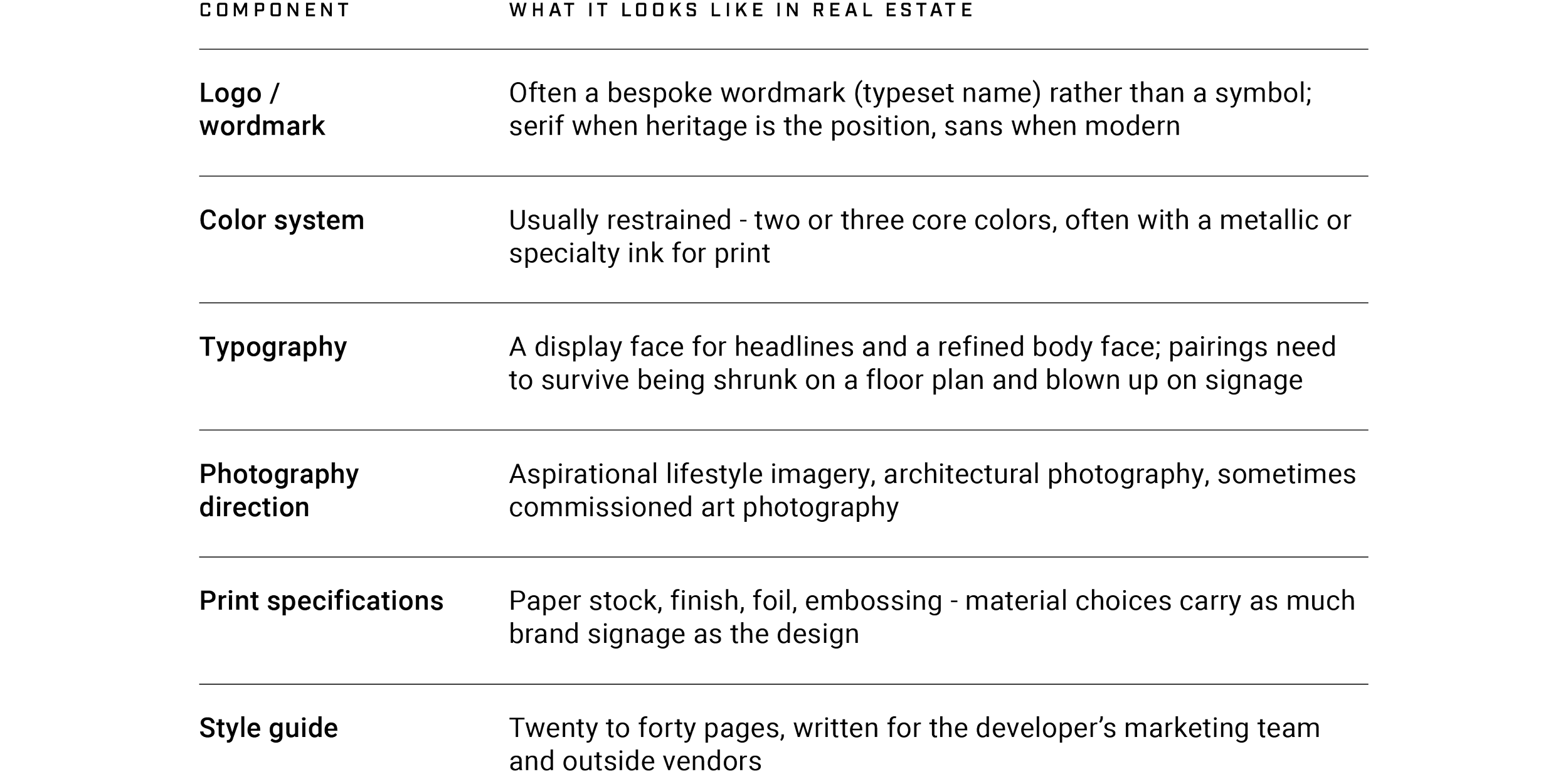
Print specifications for luxury real estate branding - foil, emboss, and paper stock
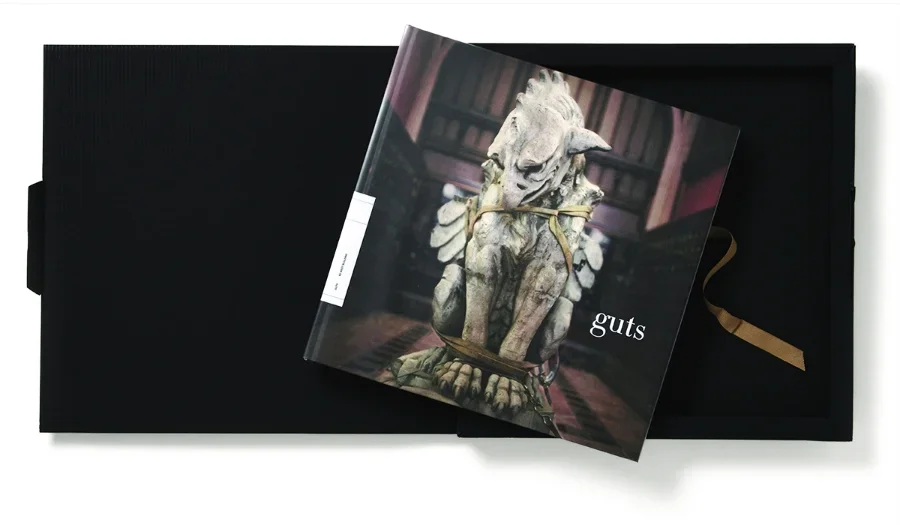
The decisions that matter most here aren't on the screen. They're in the print specs. A logo embossed in gold foil on uncoated heavyweight stock reads as luxury before a buyer has registered the design. A logo printed flat on glossy 80lb stock reads as commodity, regardless of how good the artwork is. We always specify finishes alongside the design, because in real estate the brochure is the brand, and the brochure is a physical object.
Step 4: Brand applications
Two to four weeks, often running in parallel with the tail end of identity design. This is where the brand shows up in the world.
The standard application set for a Manhattan luxury launch:
Sales brochure. The single most important asset. Forty to eighty pages, custom-printed, often with a custom slip case. The brochure is the closing tool; it has to survive being held by a buyer who's already touring three other buildings.
Floor plans. Frequently overlooked. Beautifully designed floor plans signal that the developer respects the buyer's intelligence.
Project website. Usually the second touchpoint after a NY Times or StreetEasy ad. Has to load fast, look magnificent on mobile, and book a sales gallery appointment in two clicks.
Sales center / gallery design. The brand expressed in physical space - wall graphics, finish samples, scale models, presentation systems.
Construction site signage. The largest billboard the project gets. Underused by most developers; a real branding opportunity for projects with long build timelines.
Print and digital advertising. NY Times spreads, The Real Deal, Curbed, StreetEasy, geo-targeted digital. The campaign runs for the duration of the sales effort.
PR and launch event. The brand applied to invitations, press kits, and the launch event itself.
For 303 East 33rd, the application set extended to a full ad campaign of playful icons pairing the building's amenities with Murray Hill neighborhood references - bocce ball, cocktail glasses, popcorn. Ivanka Trump saw one of the ads and faxed it to the developer with praise. That's the kind of unexpected reach a strong applied identity creates.
Step 5: Real-world example - how we branded 303 East 33rd
303 East 33rd was a Toll Brothers condominium in Murray Hill - the first LEED-registered project in the developer's portfolio. The brief was unusual: communicate green-building credibility without making the brand feel preachy or earnest, and do it in a price band where buyers were used to glossy luxury cues, not sustainability messaging.
The positioning we landed on: opulent green. Luxury that happens to be green, not green that happens to be luxury. Same fact, opposite emphasis.
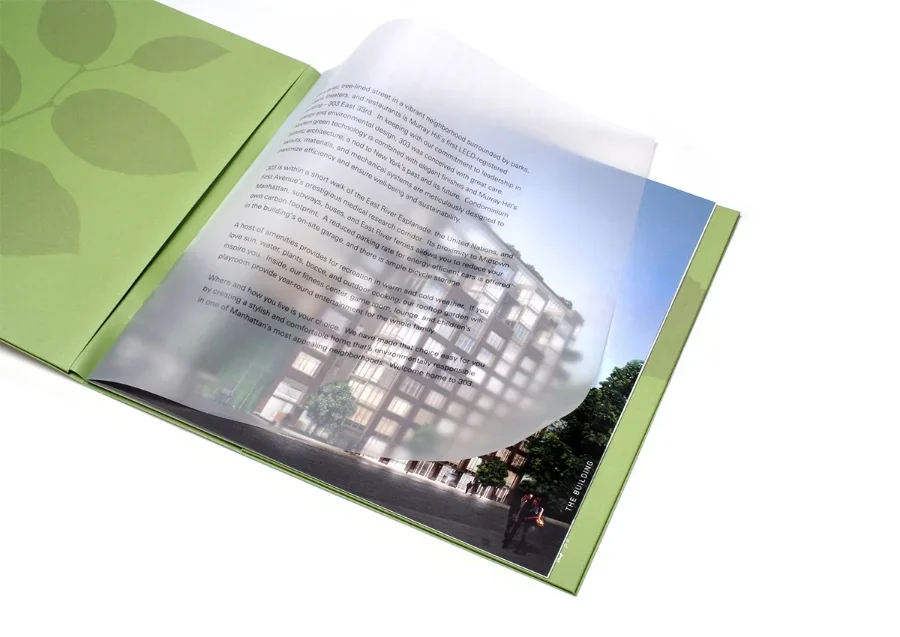
The identity used a "303-in-a-tree" mark - the building number nested inside an organic tree silhouette - rendered with soft lines and an organic pattern system. The brochure was built as a custom slip case with a debossed organic logo on the sleeve, and inside, a brochure that opened from the center spread outward in widening pages. The structure mirrored the brand idea: every layer revealed more of the building, like exploring an actual home.
The advertising campaign ran in the NY Times and paired unit amenities with iconic Murray Hill neighborhood items - bocce ball, pastrami, popcorn - using a playful illustrated icon system. The campaign tied the building to its neighborhood in a way that made the project feel inevitable to buyers already considering the area. Site signage carried the same icons, creating continuity from ad to construction site to sales center to brochure.
Result: over 60% of units sold in the first couple of months from launch, at premium pricing, against comparable Murray Hill product.
303 East 33rd ad campaign by Flying Machine for Toll Brothers - Murray Hill neighborhood icon series
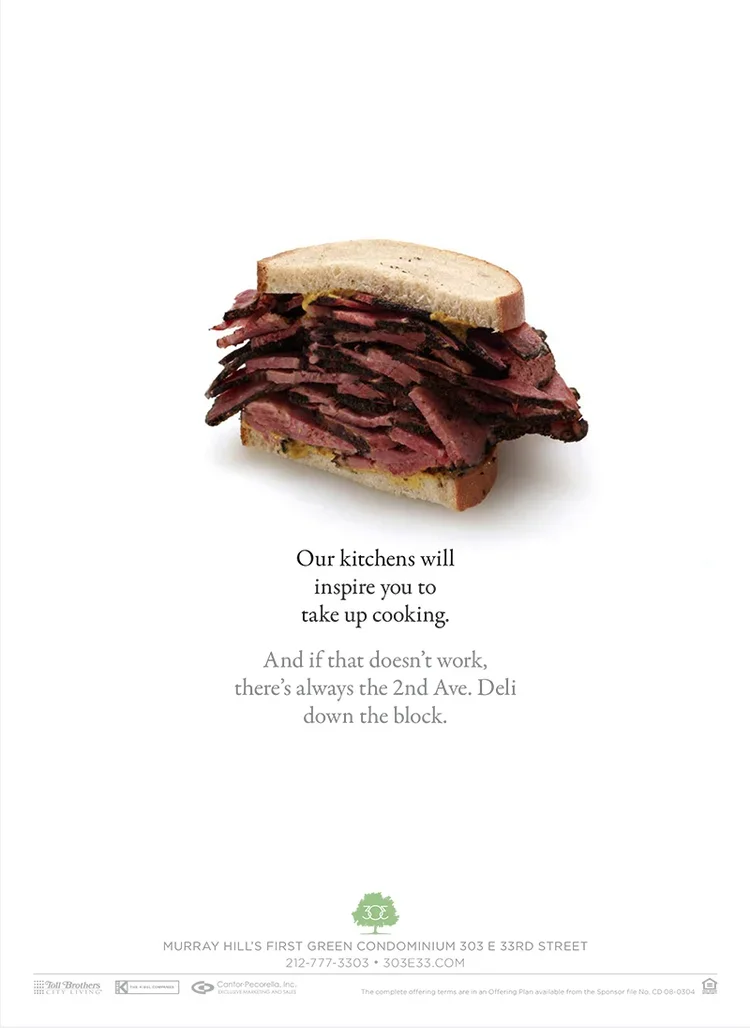
303 East 33rd ad campaign by Flying Machine for Toll Brothers - Murray Hill neighborhood icon series
How long does luxury real estate branding take?
For a typical NYC condominium launch, plan for 12 to 20 weeks from kickoff to finished launch materials. The phase split:
Research and positioning: 2 to 3 weeks
Strategy and naming: 1 to 2 weeks
Visual identity design: 3 to 5 weeks
Brand applications (brochure, website, signage, ads): 4 to 8 weeks
Refinement and print production: 2 to 4 weeks
Print production is the under-budgeted phase. A custom-printed brochure with foil, embossing, and bespoke binding takes four to six weeks at the printer alone - that's after the design is finalized. We always recommend developers add a buffer between design completion and the public launch date.
FAQ
How do you name a real estate development?
Naming runs in parallel with strategy, takes one to two weeks, and typically produces 30 to 50 candidate names that get screened for trademark availability, URL availability, and pronunciation, then narrowed to three to five recommended directions. The best names locate the building, signal the lifestyle, and sound inevitable when said out loud.
What makes a luxury real estate brand?
A luxury real estate brand is the combination of a positioning that justifies the price premium, a visual identity that signals the lifestyle (typography, color, photography, print finishes), and an application set - brochure, website, sales center, signage, advertising - that maintains brand consistency across every buyer touchpoint from first ad impression to closing.
What branding materials does a residential development need?
A standard launch package includes a sales brochure (40 to 80 pages, custom-printed), floor plans, project website, sales center design, construction site signage, print and digital advertising assets, and PR materials. The brochure is the most important single asset; the website and signage do the most consistent ongoing work.
How long does real estate branding take?
A complete real estate brand project for a Manhattan launch runs 12 to 20 weeks: 2 to 3 weeks of research and positioning, 1 to 2 weeks of strategy and naming, 3 to 5 weeks of visual identity, and 4 to 8 weeks of brand applications. Print production adds another 4 to 6 weeks before public launch.
How much does real estate branding cost?
A full real estate brand identity from a boutique NYC studio typically runs $75,000 to $300,000 depending on scope, deliverables, and print specifications. Print production (brochures, signage) is a separate budget that can run $25,000 to $150,000 depending on quantity and finishes. Larger campaigns and global launches scale higher.
Ready to talk?
Flying Machine is a boutique branding studio based in Manhattan. We've built brand identities for some of New York's most-watched residential launches, including 50 Clinton Street for Douglas Elliman, the HFZ Capital Group corporate identity, and 303 East 33rd for Toll Brothers. If you're planning a luxury residential launch and want to talk through the brand work, get in touch - or see more of our real estate branding work.